
High Winds and Dust Storms
High Winds and Dust Storms
High winds outside of thunderstorms and tropical storms may not always get the attention of hurricanes, tornadoes and floods, but they can be very stressful to drive in for a sustained period of time, they can last for days on end, and they can move and push the RV around in unpleasant ways when detached and camping.
In extreme cases, high winds can flip your rig or drive large debris, trees or tree limbs through or on top of your rig. In the deserts, high winds can also kick up large dust storms; these can have deadly consequences on high-speed roads.
In this section I’ll cover high winds when detached and camping, and when on the road. I’ll also discuss dust storms.
Like the other hazardous weather the “Ready – Set – Go!” approach will serve you well. You can find graphics of the next three day’s wind outlook here under ‘Wind Gusts’. Between 12 hours and 2 days in advance, the National Weather Service will issue a ‘High Wind Watch’, and then either a Wind Advisory or High Wind Warning when high winds are imminent. Similar to winter storms, the exact criteria for the Warnings varies by region of the country. In general, the thresholds are highest out West and lowest in the Southeast.
Camping or Boondocking in High Winds:
- It should go without saying, but you should retract all your awnings!
- In general, you want to do what you can to reduce your profile and surface area to the oncoming wind, maximize your stability, and lower your center of gravity.
- If you have the ability, park your RV such that it faces the oncoming winds.
- Pull in or minimize your slide-outs.
- Fill your fresh-water tanks if possible.
- If you are in a travel trailer or fifth wheel, hitch back up to add weight and stability from your tow vehicle.
- Put down your stabilizers.
- Check your surroundings. What may blow into your rig or fall on your roof? Can you move or minimize that potential hazard?
- Do you have the option of parking on the lee side of a hill or building that would provide you shelter?
High Winds on the Road
Sustained high winds while piloting your Rig can lead to a very stressful and tiring day. It will matter a lot if the winds are generally from the front (head-winds), from the side (cross-winds) or from the rear (tail-winds).
Tail winds are the easiest to drive in. They reduce the wind resistance, relative to your true speed, and for most rigs, do not greatly impact the stability of your ride or tow. As a bonus, a good tail-wind can substantially improve your fuel mileage!
Head winds will buffet your rig and/or tow vehicle. They will greatly decrease your fuel mileage and make you feel like you are constantly buffeted.
Cross winds will try and push you to one side of your travel lane or the other. You might even see other rigs or semi-trucks “crabbing” down the road, basically driving at an angle to go in a straight line. You will also likely get large changes in winds when you pass or are passed by another large vehicle — be prepared for that.
Here are some tips:
- Slow down. The faster you go, the more impact the winds have on your control.
- Both hands on the wheel. Be prepared to be buffeted and pushed around by both the winds and sudden changes when close to another vehicle.
- Take more breaks. You will be concentrating harder than usual.
- Watch out for the other guy! They may be having a harder time than you maintain lane discipline, or control at all. Give vehicles more space than usual.
- Know your limits. Many factors combine, including the weight and aerodynamic characteristics of your rig, your hitch, anti-sway and weight distribution setup, quality and width of the road, what type (head, cross, tail) wind you are dealing with, how much traffic is on the road, and your own experience and comfort level.
- If the situation is getting beyond your comfort level, pull off the road. You might be delayed a day or two. Oftentimes the highest winds are between lunch and dinnertime, so maybe an early morning start and early afternoon finish will be best.
How much wind is too much?
Like so many other things in RV’ing, “it depends.” It depends on many of those factors listed above. I have had RV Weather users who were terrified to tow in 30-35 mph (gust) crosswinds, and others who were nonplussed by winds gusting 60-65 mph (they were in a 36,000 lb converted bus).
My personal comfort level is under 30 mph gusts — no worries. 30-40 mph gusts — both hands on the wheel and pay attention. 40-55 mph gusts — this is pretty sporting and the fun-meter is pegging low. Gusts 55 mph or higher — it’s time to get off the road and let the winds die off.
I think most RV’ers are OK handling gusts up to 40 or 45 mph. After that, you need to be very careful and know both your abilities at that time and the characteristics of your rig.
Where to get wind information
If you look through the RVWeather.com homepage, there are a number of places to get wind information, from the current weather warnings and latest forecasts, to the animation of wind gusts, wind gusts for the next three afternoons, and an outlook for high winds over the next week (under the “3-7 Day Hazards Outlook”).
Dust Storms
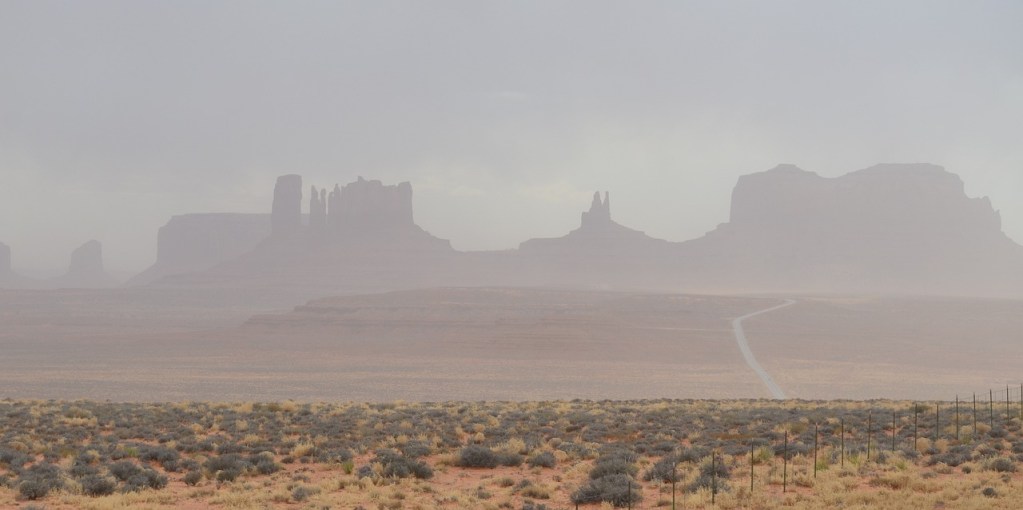
One hazard with high winds that can catch people unawares is dust, and specifically, walls of blowing dust and sand that can turn day into night and instantly reduce visibility to near zero. The desert southwest is particularly susceptible to these storms. Unfortunately, they can lead to large pile-ups on high-speed highways and multiple deaths, as cars, trucks and RVs slam into stopped vehicles they could not see.
The Arizona Department of Transportation (ADOT) has a 30-second video showing you what it is like to drive into a Dust Storm and lose all visibility.
Here’s what to do:
- If you have any way to avoid the dust storm — do not drive into it. Avoidance is by far the safest option.
- If you are caught in a dust storm
- Pull as far to the side of the road and out of the travel lanes as you can be.
- Keep your seat belt on.
- Take your foot OFF the brake.
- TURN YOUR LIGHTS OFF!
You turn your lights off so a vehicle behind you doesn’t crash into you, thinking they are following a car or truck in the travel lane.
“Pull Aside — Stay Alive!”

Follow Us: